BMW M5 vs M8
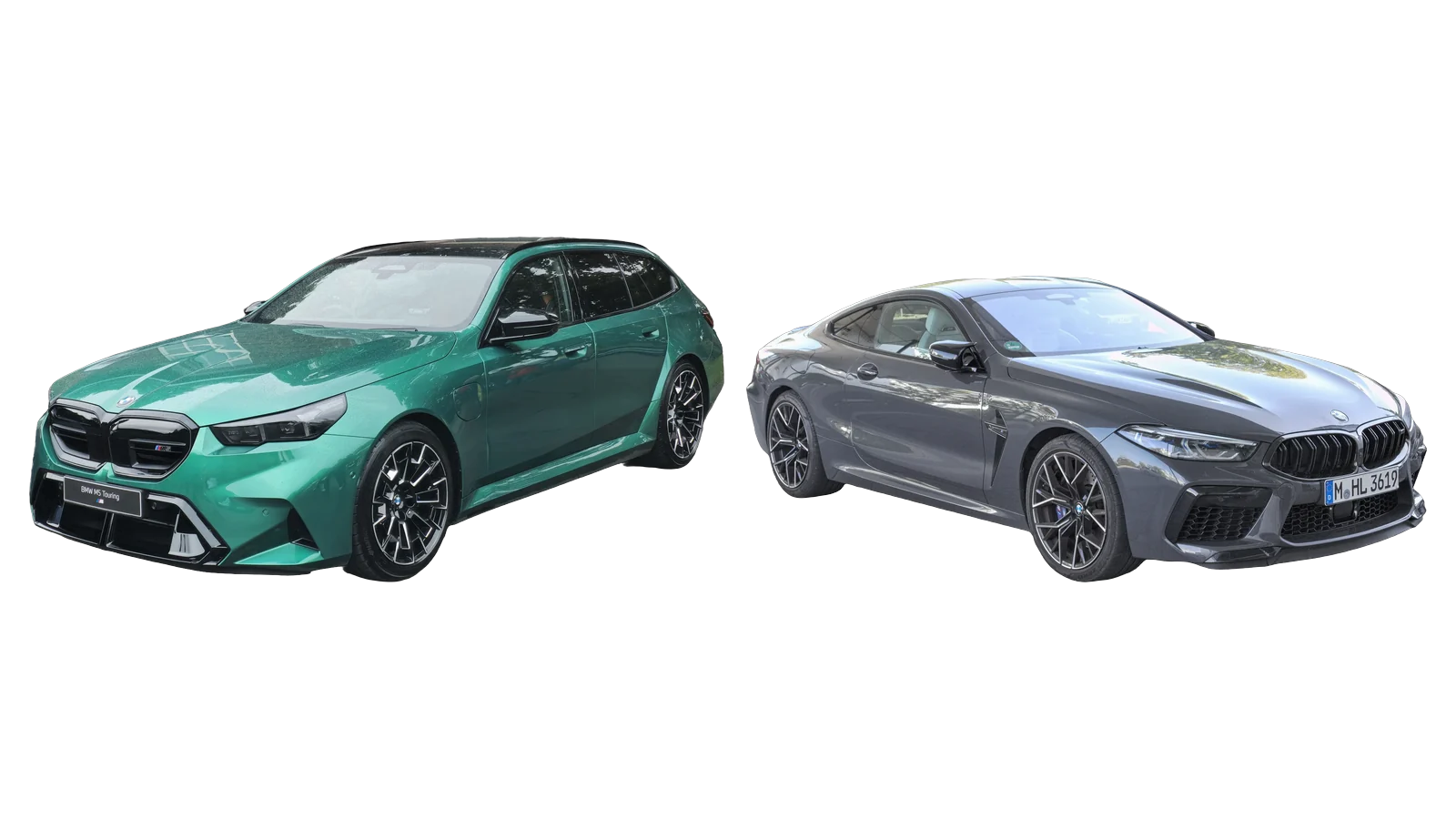
M5 or M8? Side-by-side specifications from the original factory data: engine, power, economy, dimensions and weight.


| Parameter | M5 2025 | M8 2025 |
|---|---|---|
| Engine | 8-cyl · 4.4L · turbo · Premium Gasoline | 8-cyl · 4.4L · turbo · Premium Gasoline |
| Displacement, cc | 4400 | 4400 |
| Cylinders | 8 | 8 |
| Power, hp | 577 | 617 |
| Transmission | Automatic (S8) | Automatic (S8) |
| Drivetrain | All-Wheel Drive | All-Wheel Drive |
| Parameter | M5 2025 | M8 2025 |
|---|---|---|
| MPG city | 11 | 15 |
| MPG highway | 17 | 22 |
| MPG combined | 13 | 17 |
| CO₂, g/mile | 304 | 517 |
| Electric range, mi | 25 | — |
| Parameter | M5 2025 | M8 2025 |
|---|---|---|
| Length, in | 200.8 | 191.3 |
| Width, in | 77.6 | 74.8 |
| Height, in | 59.8 | 53.1 |
| Wheelbase, in | 118.5 | 111.0 |
| Parameter | M5 2025 | M8 2025 |
|---|---|---|
| Curb weight, lb | 5622 | — |
Fuel economy from the U.S. EPA, power from EPA certification data, dimensions and weight from Transport Canada, torque, acceleration and top speed from BMW factory brochures.
What the table shows
The two columns are a 2025 M5 and a 2025 M8, taken from the specification cards behind this site rather than from a manufacturer’s press release. The starting version of a shared model year is used on both sides, so the comparison is base against base.
- Power: the M8 is more powerful by 40 hp — 617 against 577, 7% more.
- Combined economy: the M8 is more economical by 4 mpg — 17 against 13, 31% more.
- Length: the M5 is longer by 9.5 in — 200.8 against 191.3, 5% more.
Both use a 4.4-liter turbocharged V8. Certification data does not name the engine family for both cards, so we cannot say from our own records whether that is one engine or two. Both drive all four wheels.
Rows the table leaves blank are figures neither card carries. Torque, acceleration and top speed are not collected by any US government source and appear on this site only where an original factory brochure printed them, so they are missing more often on recent cars than on older ones.