BMW B58 Engine
BMW B58 (2015-): specifications, power by application and every car that has it.
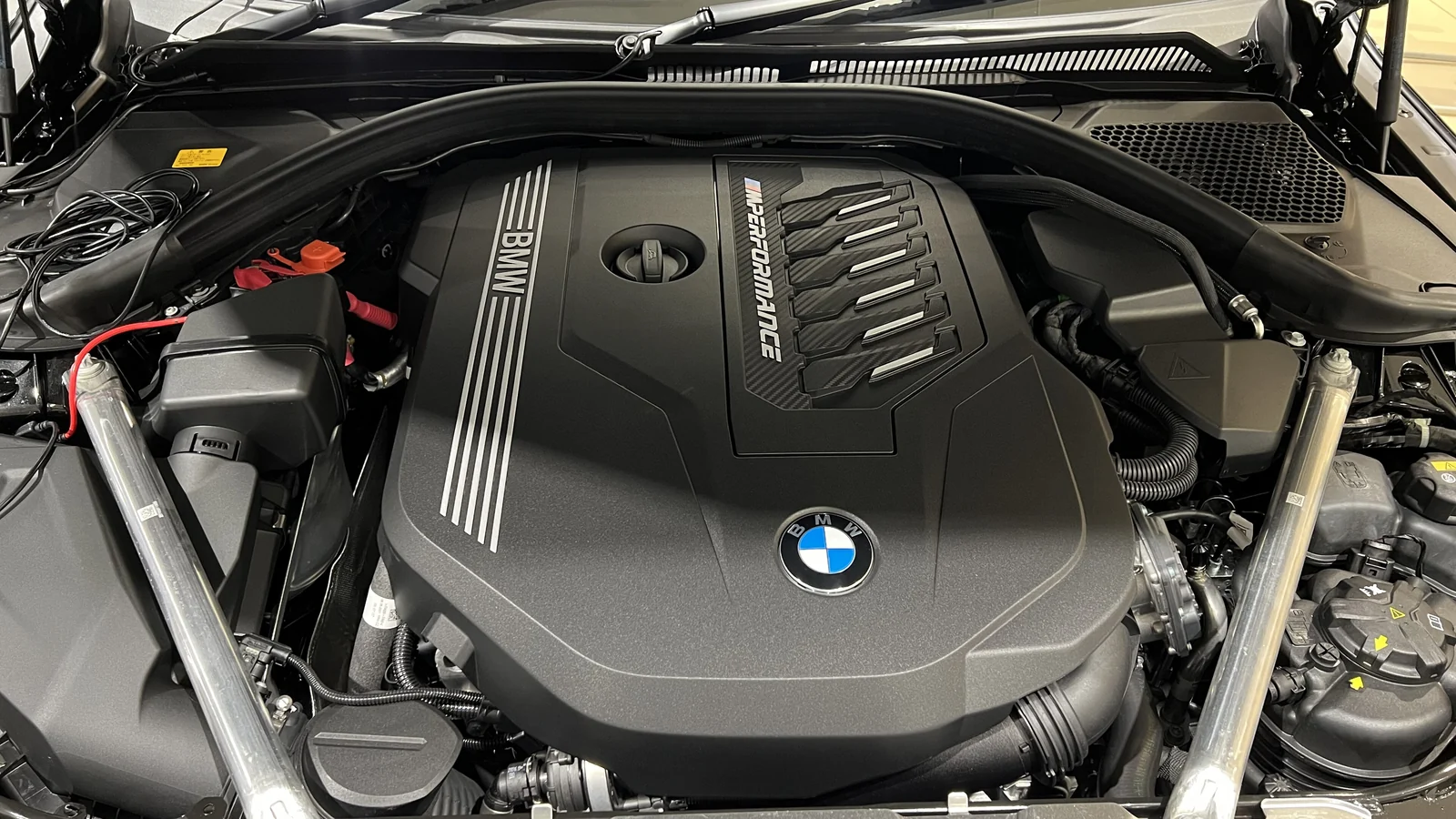

- Displacement
- 3.0 L
- Layout
- Inline-6 turbo petrol
- Power range
- 320–382 hp
- Produced
- 2015–now
The B58 is BMW’s 3.0-liter turbocharged inline-six, in production since 2015 and still the engine BMW reaches for whenever a car needs six cylinders and does not wear an M badge. It replaced the N55 and, in the US market, has been fitted to twelve different model lines so far — from a 3,463 lb Z4 roadster to a 5,417 lb seven-seat X7. This page covers the engine itself and the application guide: its five rated outputs, what it has to move in each car, and which of the twelve is the one worth buying, built from the 173 US-certified versions in our specification records that carry it.
What the B58 is
A 3.0-liter inline-six with a single twin-scroll turbocharger, direct injection and variable valve timing and lift. Displacement is 2,998 cc in every US application recorded in EPA certification data — there is no “small” or “large” B58, only different states of tune.
It is one of three engines in BMW’s modular B-family, all sharing the same 500 cc per cylinder: the three-cylinder B38, the four-cylinder B48 and the six-cylinder B58. That commonality is the point of the family — the same bore, stroke and much of the same hardware scaled across three different cylinder counts.
Five outputs, and how to tell which one you are looking at
The B58 has never been sold at one power figure. EPA certification records give five distinct ratings across its US life, and they map onto badges rather than onto years:
| Rated output | US model years | Badges that carry it |
|---|---|---|
| 320 hp | 2016–2018 | 340i |
| 335 hp | 2017–2026 | 540i, 740i, 840i, sDrive40i, xDrive40i |
| 355 hp | 2018–2019 | M40i (X3, X4) |
| 375 hp | 2023–2026 | 540i, 740i, M340i, M440i, M50i, sDrive40i, xDrive40i |
| 382 hp | 2020–2026 | M240i, M340i, M440i, M40i |
The rule that falls out of it is simple and worth carrying to a dealer lot. A 40i badge is the 335 hp or 375 hp engine; an M-something-i badge is the 355 hp or 382 hp engine. The plain 340i of 2016–2018 is the outlier: it is the lowest output the B58 has ever been sold at in America, and it is also the first.
Sixty-two horsepower separates the bottom of that table from the top, inside one engine family at one displacement. A listing that says “3.0-litre TwinPower Turbo six” therefore tells you almost nothing about how quick the car is; the badge and the model year do.
What BMW said when it launched
The archive holds the US brochure from the B58’s first American model year. The 2016 3 Series brochure introduces it in one sentence, under a heading about power and efficiency: “An all-new 3.0-liter inline six-cylinder engine in the 340i pours on 320 hp with 330 lb-ft of torque.”
Two things in that sentence are worth noticing a decade later. “All-new” is BMW distinguishing it from the N55 it replaced, which shared the displacement and the layout but not the architecture. And 320 hp with 330 lb-ft · 447 Nm is the figure the engine started at — the same brochure lists the 328i’s four-cylinder at 240 hp and 255 lb-ft, and a diesel at 180 hp and 280 lb-ft, so the six was the top of the ordinary 3 Series range by 80 hp.
The twelve cars, and what the engine has to move
This is where the application guide earns its keep. The same engine, in twelve different bodies, with the weight and the fuel economy that follow from them:
| Model | US model years | Badge | Output | Curb weight | EPA combined |
|---|---|---|---|---|---|
| Z4 | 2020–2026 | M40i | 382 hp | 3,463 lb | 22–26 mpg |
| 3 Series | 2016–2026 | 340i, M340i | 320–382 hp | 3,545–3,825 lb | 23–29 mpg |
| 5 Series | 2017–2026 | 540i | 335–375 hp | 3,682–4,019 lb | 23–28 mpg |
| 2 Series | 2022–2026 | M240i | 382 hp | 3,891–3,933 lb | 26 mpg |
| 4 Series | 2021–2026 | M440i | 375–382 hp | 3,977–4,189 lb | 25–30 mpg |
| X3 | 2018–2025 | M40i, M50i | 355–382 hp | 4,228 lb | 23–27 mpg |
| X4 | 2019–2024 | M40i | 355 hp | 4,323 lb | 23 mpg |
| 7 Series | 2020–2026 | 740i | 335–375 hp | 4,720 lb | 23–28 mpg |
| X5 | 2019–2026 | sDrive40i, xDrive40i | 335–375 hp | 4,707–5,302 lb | 22–25 mpg |
| X6 | 2020–2026 | sDrive40i, xDrive40i | 335–375 hp | 4,795 lb | 22–24 mpg |
| X7 | 2019–2026 | xDrive40i | 335–375 hp | 5,280–5,417 lb | 21–23 mpg |
| 8 Series | 2020–2026 | 840i | 335 hp | — | 23–25 mpg |
The weight column spans 1,954 lb · 886 kg from top to bottom. A Z4 M40i and an X7 xDrive40i share an engine family and are separated by most of a ton — and the X7 is the one with the lower output, because the 40i badge sits below the M40i badge. That is the least intuitive fact about the B58 range: BMW gives the biggest, heaviest cars the softer tune.
Which one to buy
Read the table for the ratio rather than the headline and three cars separate themselves.
The Z4 M40i is the extreme. 382 hp in 3,463 lb is the lightest car the B58 has ever been put in for the US market, and it is the highest output. Nothing else in the range is close: the next lightest is the 3 Series at 3,545 lb, and that one starts at 320 hp.
The M240i is the value case. 382 hp, 3,891 lb, and 26 mpg combined — the same output as the Z4, in a car that is 428 lb heavier but returns better economy than most of the range. Its EPA figure is bettered only by the M440i and the 3 Series at the top of their spans.
The X7 xDrive40i is the one to check carefully. 5,280–5,417 lb on 335 to 375 hp and 21–23 mpg makes it the hardest-worked B58 in the range. It is not a criticism of the engine so much as an observation about what you are asking of a 3.0-liter six: the X7 weighs 56% more than the Z4 with less power.
Across all 173 versions the median EPA combined figure is 25 mpg and the range is 21 to 30. For a 3.0-liter turbocharged six that spends half its life in SUVs, that is a narrow band — the engine’s economy is remarkably insensitive to what it is bolted into, which is not true of its acceleration.
What the six buys over the four
In most of the cars listed above the B58 is the upgrade from BMW’s 2.0-liter four-cylinder, the B48. Because both are certified in the same model years and the same models, the trade can be measured rather than argued about. Our records hold 35 pairs where the same model in the same year was sold with both:
| What changes | Median difference | Range |
|---|---|---|
| Rated output | +120 hp | +72 to +157 hp |
| Curb weight | +167 lb · 76 kg | — |
| EPA combined | −2 mpg | — |
A 120 hp median uplift for two combined mpg and 167 lb is an unusually favorable trade, and it has become more favorable over time. In 2017 the 3 Series six gave 72 hp over its four; by 2020 the M340i gave 127 hp over the 330i, and the X3 M40i 134 hp over the X3 30i. The four-cylinder did not get worse — the six-cylinder tune moved up.
The two-mpg penalty is the number most likely to surprise. Two extra cylinders and half again the displacement cost, on the EPA combined cycle, about as much as choosing all-wheel drive does. That is not an argument that the six is efficient; it is an observation that the combined cycle rewards a large engine running lightly loaded, which is exactly the condition a 3.0-liter six is in for most of the test.
How the outputs moved
The five ratings are not five engines. They are one engine family through three recognizable phases, and the dates in our records line up cleanly.
2016–2019: the introduction. 320 hp in the 340i, 355 hp in the X3 M40i from 2018 and the X4 M40i from 2019. The M40i models are the first sign that BMW intended to use this engine as a performance unit rather than only as the six-cylinder option.
2020–2022: the step to 382. The M240i, M340i, M440i and the Z4 and X3 M40i all arrive at 382 hp. This is the phase where the “M Performance” tune becomes the B58’s headline figure, and where the gap to the plain 40i cars opens to 47 hp.
2023–2026: 375 becomes the standard. The 540i, 740i, X5 and X7 move from 335 to 375 hp, closing most of the gap to the M cars. By this point a 740i has more power than a 2019 X4 M40i did.
Anyone comparing a used 540i against a newer one should note that step specifically: 2017–2022 cars are the 335 hp version and 2023 onwards the 375 hp version, and the badge does not change.
Checking which one a particular car has
Three steps, none of which require opening the hood.
Establish the model year and model from the VIN — our VIN decoder returns both, and the method is set out in how to decode a BMW VIN.
Look up that year and trim on our specification pages. The horsepower shown there is from the EPA certification record for that version, not from a press release, and the engine family is named where the certification data supplies it.
Do not rely on the badge alone. A 540i is 335 hp or 375 hp depending on year; a 40i is 335 or 375; an M40i is 355 or 382. In every case the model year is what resolves it.
It also powers a Toyota
BMW supplies the B58 to Toyota for the GR Supra, which shares its platform with the Z4. This is worth stating plainly because it is the one case where searching for a BMW engine leads you to a car that is not a BMW: the six-cylinder Supra is B58-powered, built alongside the Z4, and its engine is the same unit described on this page.
What is missing from the table, and why
Two columns you would expect in a guide like this are not there: torque and 0–60. Neither is an oversight.
Torque and acceleration are not collected by any US government source. EPA certification records horsepower and fuel economy; Transport Canada records dimensions and curb weight. Torque figures exist in our records only where a factory brochure printed them in a specification table — and our brochure archive thins out sharply after 2019, which is exactly the period covering most of the B58’s life. Of the 173 B58 versions on file, none carries a torque figure from a source we can name, so the column stays empty rather than being filled from a press release someone else has already re-typed twice.
The one torque figure on this page — 330 lb-ft · 447 Nm for the 2016 340i — is here because BMW printed it in the brochure we hold, and the page links to that brochure so you can read the sentence yourself. That is the standard the rest of the table would have to meet.
The 8 Series row has no curb weight for the same kind of reason: Transport Canada does not publish one for that model, so the cell is a dash. A dash on this site means “not published by a source we can cite”, never “roughly the same as the row above”.
What we can and cannot tell you about reliability
We do not publish a reliability verdict for the B58, and the reason is worth being straight about: there is no first-party source for one.
BMW does not publish failure rates or service-life figures for its engines. The NHTSA complaints database, which is public and which we do use elsewhere on this site, records complaints against a vehicle — “2019 BMW 3 SERIES” — not against an engine. A 2019 3 Series in that database may be a 330i with the four-cylinder B48 or an M340i with the B58, and the database does not separate them. Any figure claiming to be “B58 complaints” has been derived by guesswork somewhere along the way.
What we can give you is the part that is verifiable: which car has which engine, in which years, at what output — the table above — and the ability to check an individual car. If you are looking at a specific vehicle, its VIN carries the answer, and the specification pages hold the recorded figures for that model year.
Common questions
How much horsepower does the B58 make?
Between 320 and 382 hp in US-market cars, depending on the model and model year. The 2016 340i was certified at 320 hp; the M240i, M340i and Z4 M40i sit at 382. All are the same 3.0-liter displacement.
Which BMWs have the B58?
In the US: the M240i, 340i and M340i, M440i, 540i, 740i, 840i, X3 M40i, X4 M40i, X5 40i, X6 40i, X7 40i and Z4 M40i. The table above gives the model years for each.
What engine did the B58 replace?
The N55, BMW’s previous single-turbo 3.0-liter six, which ran from 2009 to 2016. The B58 arrived for the 2016 model year in the US, in the 340i.
Is the B58 the same engine as the S58?
No. The S58 is the M division’s twin-turbo development of the same 3.0-liter architecture, used in the M3, M4, X3 M and X4 M, and it makes 453–543 hp in US cars. The two are related but not interchangeable.
Does the Toyota Supra use the B58?
The six-cylinder GR Supra does. BMW supplies the engine to Toyota, and the Supra is built alongside the BMW Z4.
Is the B58 a 2.0 or a 3.0 engine?
3.0 liters — 2,998 cc in every US application on record. The 2.0-liter turbo four in the 330i and X3 30i is the B48, a different engine from the same modular family.
Which BMW has the most powerful B58?
The 382 hp version, fitted to the M240i, M340i, M440i and the Z4 M40i and X3 M40i. In the Z4 that output moves the lightest car in the range at 3,463 lb.
Is the 540i B58 the same as the M340i B58?
Same engine family, different tune. Through 2022 the 540i was rated at 335 hp against the M340i’s 382; from 2023 the 540i moves to 375 hp.
What fuel economy does the B58 return?
21 to 30 mpg combined depending on the car, with a median of 25 across all 173 US-certified versions. The M440i and 3 Series reach 29–30; the X7 and X4 sit at 21–23.
Is a B58 in an X7 the same engine as in a Z4?
The same family, differently rated and doing a very different job: 335–375 hp in a 5,280–5,417 lb X7 against 382 hp in a 3,463 lb Z4.
Sources
- EPA — Annual certification test data: rated horsepower, displacement and engine family codes for every US-certified model year, 1998 to date. The output figures and the 2,998 cc displacement in this article come from these records.
- EPA / DOE fueleconomy.gov: model-year coverage and trim listings for the US market.
- NHTSA — datasets and APIs: the complaints database referred to above, which records complaints by vehicle rather than by engine.
- The 2016 BMW 3 Series US brochure held in this site’s archive, source of the launch description and the 320 hp / 330 lb-ft figures.
- Curb weights from Transport Canada vehicle specifications, via this site’s specification pages.
Cars with this engine
Years and output by model
| BMW 2 Series | 2018–2026 · 335–382 hp |
| BMW 3 Series | 2016–2026 · 320–382 hp |
| BMW 4 Series | 2018–2026 · 322–382 hp |
| BMW 5 Series | 2017–2024 · 335–375 hp |
| BMW 6 Series | 2019–2019 |
| BMW 7 Series | 2023–2025 · 375 hp |
| BMW 8 Series | 2020–2026 · 335 hp |
| BMW X3 | 2018–2024 · 355–382 hp |
| BMW X4 | 2019–2019 · 355 hp |
| BMW X5 | 2019–2026 · 335–375 hp |
| BMW X6 | 2020–2026 · 335–375 hp |
| BMW X7 | 2019–2026 · 335–375 hp |
| BMW Z4 | 2020–2026 · 382 hp |