BMW M20 Engine
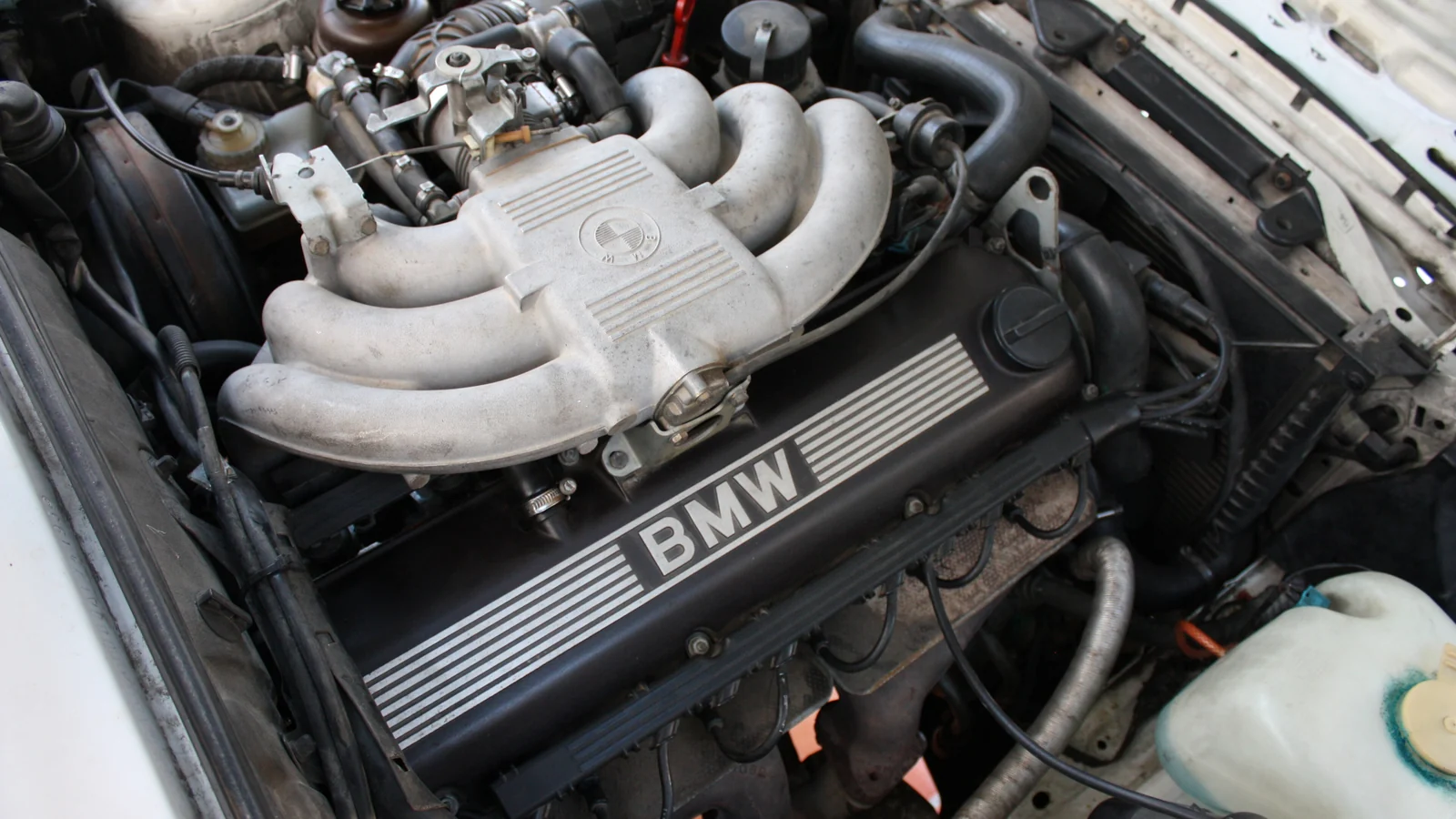
BMW M20 (1977-1993): specifications, power by application and every car that has it.

- Displacement
- 2.5 L
- Layout
- Inline-6 NA petrol
- Produced
- 1977–1993
The M20 is BMW’s “little six” — a compact single-overhead-cam inline-six built from 1977 to 1993, and the engine that made a six-cylinder 3 Series possible. It is also the engine of the eta experiment, one of the more interesting things BMW did in the 1980s, and one our archive can document from the brochures themselves.
What the M20 is
A cast-iron-block inline-six with an aluminum cylinder head and a belt-driven single overhead camshaft, built in 2.0, 2.3, 2.5 and 2.7-liter forms. It was designed to be short enough to fit where a four-cylinder engine had gone.
The 1987 3 Series Convertible brochure describes the 325i version exactly: “Under the hood is a 2.5 liter, 6-cylinder engine with 168 hp and maximum torque of 164 ft./lb, with Digital Motor Electronics for maximum engine efficiency.” The same brochure’s technical data gives the construction: “Water-cooled 2.5 ltr., 6-cylinder 4-stroke inline engine, longitudinally mounted and inclined, light-alloy cylinder head, overhead camshaft with 7 bearings, crankshaft running in 7 bearings with 12 counterweights and torsional vibration damper.”
The eta engine, in BMW’s own words
The most unusual M20 is the 2.7-liter “eta” of the 325e and 528e, and the 1985 3 Series brochure explains what BMW was attempting more clearly than most later accounts do.
The brochure sets out the problem as throttling losses — an engine at part throttle “breathing through a stuffy nose”, in its phrase. The solution: “BMW engineers increase breathing efficiency in the load and rpm ranges most used by BMW drivers. At the same time, they decrease the final drive ratio, thereby lowering the Eta’s engine’s rotational speeds (rpm). An idle control is added to reduce idling speeds. Then, to retain the Eta’s acceleration ability despite the lower rpm level, engine torque (or power) at low and medium engine speeds is increased.”
That is a coherent engineering argument, made in a sales brochure, in 1985: a large-capacity six tuned for torque at low revs and geared long, rather than a small engine worked hard. The brochure credits “Digital Motor Electronics” — “this ingenious computerized engine management system helps the Eta-six extract maximum performance from minimum fuel” — for making it work.
The name is the Greek letter eta, the symbol used in engineering for efficiency. It is not an abbreviation of anything.
Where it appears in our records
| Model | US model years | Trim |
|---|---|---|
| 5 Series | 1989 | 525i |
Two specification pages, and that is the whole of what United States government records give us for an engine that ran sixteen years. Fuel economy data begins in the mid-1980s and rated power only from 1998, five years after the M20 finished. The 320i, 323i, 325e, 325i and 528e are all outside it.
The brochures fill part of that gap, and they are the reason this page can quote a horsepower figure at all: 168 hp for the 1987 325i, printed by BMW at the time.
What we do not publish
No reliability rating. The NHTSA complaint database records faults against a vehicle, not an engine, and for cars this old the surviving record reflects what people were still complaining about decades later rather than how the engine was built. The specific weakness these engines are known for — the timing belt, which is an interval item rather than a defect — is a maintenance fact, not a reliability statistic, and we are not going to dress it up as one.
Common questions
Which BMWs have the M20?
The E21 320i and 323i, the E30 320i, 323i, 325e, 325es, 325i, 325is and 325ix, the E28 528e, and the early E34 525i. In our United States specification records, which start in 1989, only the 525i appears.
How much horsepower does the M20 have?
It depends on the version. For the 2.5-liter in the 1987 325i, the brochure in this archive says 168 hp and 164 lb-ft. The 2.7-liter eta made less power and more low-end torque by design, and the smaller versions less again.
What is a BMW eta engine?
The 2.7-liter M20 fitted to the 325e and 528e, tuned for efficiency: more torque low down, a lower rev limit and longer gearing. BMW’s own explanation is quoted above from the 1985 3 Series brochure.
Is the M20 related to the M30?
They are contemporaries and both single-cam inline-sixes, but they are separate designs. The M30 is the larger “Big Six” of the 5, 6 and 7 Series; the M20 is the smaller unit built to fit the 3 Series engine bay.
What replaced the M20?
The twin-cam M50, from 1990 in the E34 and 1991 in the E36.
Sources
Quotations from the 1985 3 Series and 1987 3 Series Convertible brochures in this archive. Model years and fuel economy from EPA fuel economy data.