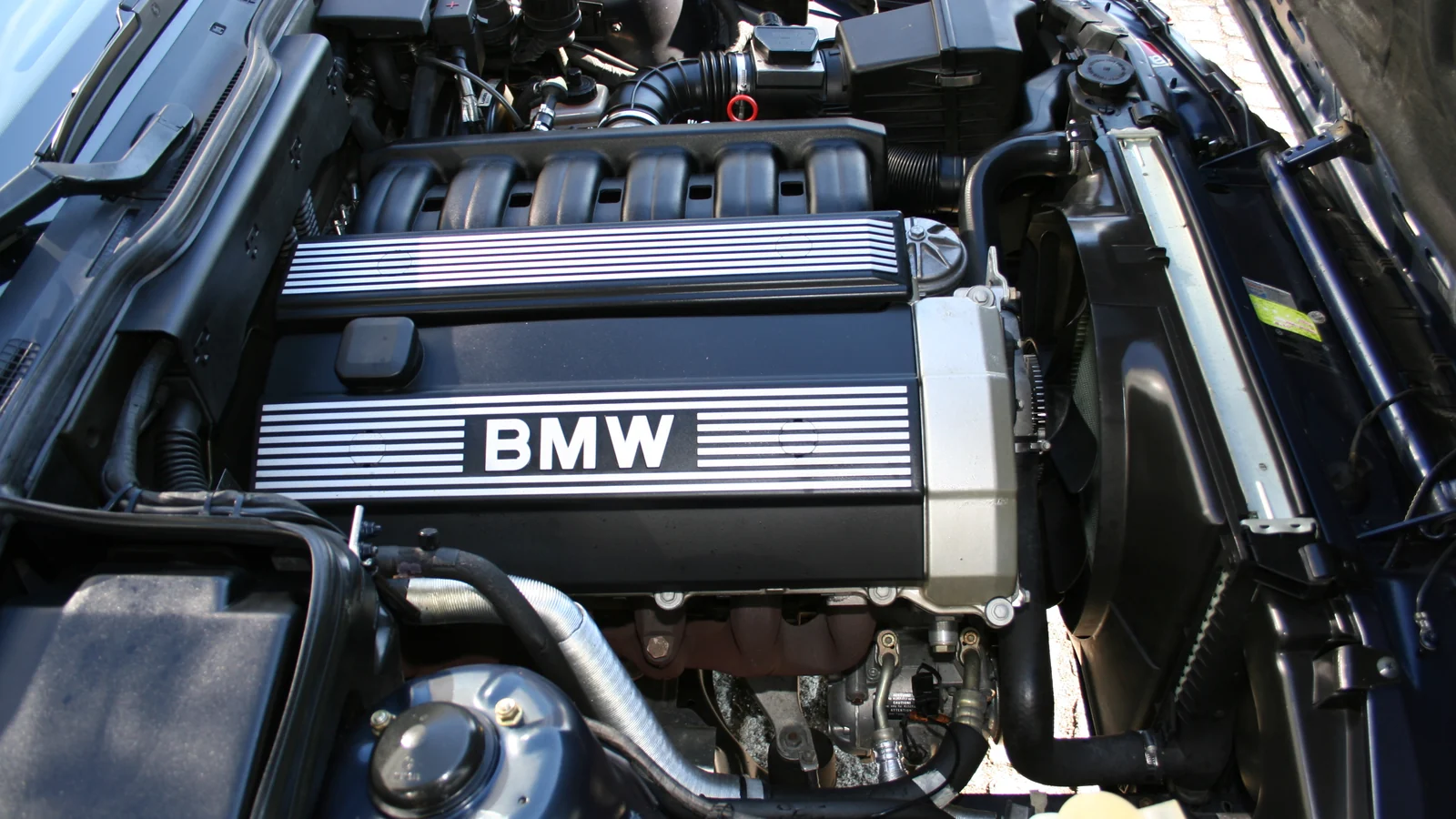
BMW M50 Engine
BMW M50 (1990-1996): specifications, power by application and every car that has it.

- Displacement
- 2.5 L
- Layout
- Inline-6 NA petrol
- Produced
- 1990–1996
The M50 is BMW’s first twin-cam inline-six for ordinary cars, built from 1990 to 1996. It replaced the single-cam M20, introduced BMW’s variable valve timing to the mainstream range, and set the pattern every BMW six since has followed.
What the M50 is
A cast-iron-block inline-six with an aluminum head, two overhead camshafts and four valves per cylinder, in 2.0 and 2.5-liter forms. From late 1992 it gained VANOS — variable timing on the intake camshaft — and the revised engine is usually written M50TU, for technische Überarbeitung, technical revision.
Two overhead camshafts and four valves per cylinder were not new in 1990; BMW had used them on M division engines since the M88. What was new was putting them in a 325i. The M50 is where that architecture stopped being special.
Where it appears in our records
| Model | US model years | Trim |
|---|---|---|
| 5 Series | 1994–1995 | 525i |
Four specification pages, all E34 525i, and nothing else. This is the thinnest coverage of any engine we track relative to how common the engine actually was, and the reason is entirely about sources: rated power appears in United States certification records only from 1998, two years after the M50 finished, and our brochure archive holds nothing from the 1990s at all. The E36 325i, the 320i and the earlier 525i are all outside what we can document.
What the fuel economy data does give is 19 to 20 mpg combined, which for a 2.5-liter six of 1994 is unremarkable and about what the single-cam engine it replaced returned. The M50’s advantage was in output, and output is precisely the field we cannot fill from a source.
The engine that set the pattern
Trace BMW’s mainstream six-cylinder engines forward from 1990 and the M50 is where the line starts: twin cams, four valves, variable timing on the intake side. The M54 of the 2000s is a direct descendant through the M52; the N52 that followed added Valvetronic and a magnesium-aluminum block but kept the layout; the B58 of today is turbocharged and direct-injected and is still recognisably the same idea.
The M50 is also where the S-prefix distinction becomes clear. The M division’s S54 and its predecessors are separate engines, not tuned M50s — a point our guide to engine codes covers, because the numbering suggests a relationship that does not exist.
What we do not publish
No reliability rating. The NHTSA complaint database records faults against a vehicle, not an engine, and a 1994 525i record does not distinguish the engine in any case. We also publish no power or torque figures for the M50: no source we use carries them, and we do not have a brochure of the period to read them from.
Common questions
Which BMWs have the M50?
The E36 320i and 325i, the E34 520i and 525i, and the E36 M3 in modified S50 form for some markets. In our United States specification records only the E34 525i of 1994 and 1995 appears.
How much horsepower does the M50 have?
We do not publish a figure, because no record we use carries one for those years. This is a gap in our sources rather than a gap in the engine’s history, and a period brochure would close it — we hold none from the 1990s.
What is the difference between M50 and M50TU?
The TU version, from 1992, added VANOS variable valve timing on the intake camshaft. It is the same basic engine with a revised head and timing arrangement.
Is the M50 related to the S50?
The S50 of the E36 M3 shares the family but is an M division engine: larger, with individual throttle bodies and a different head. As with every S-prefixed BMW engine, it is not a tuned version of the ordinary one.
What replaced the M50?
The M52, from 1995, which moved to an aluminum block. The M54 followed in 2000.
Sources
Model years and fuel economy from EPA fuel economy data, with the source named on every specification page. No brochure from this period is held in the archive; if you have one, the submission page explains what to send — the 1990s are the decade we are missing entirely.