BMW M52 Engine
BMW M52 (1994-2000): specifications, power by application and every car that has it.
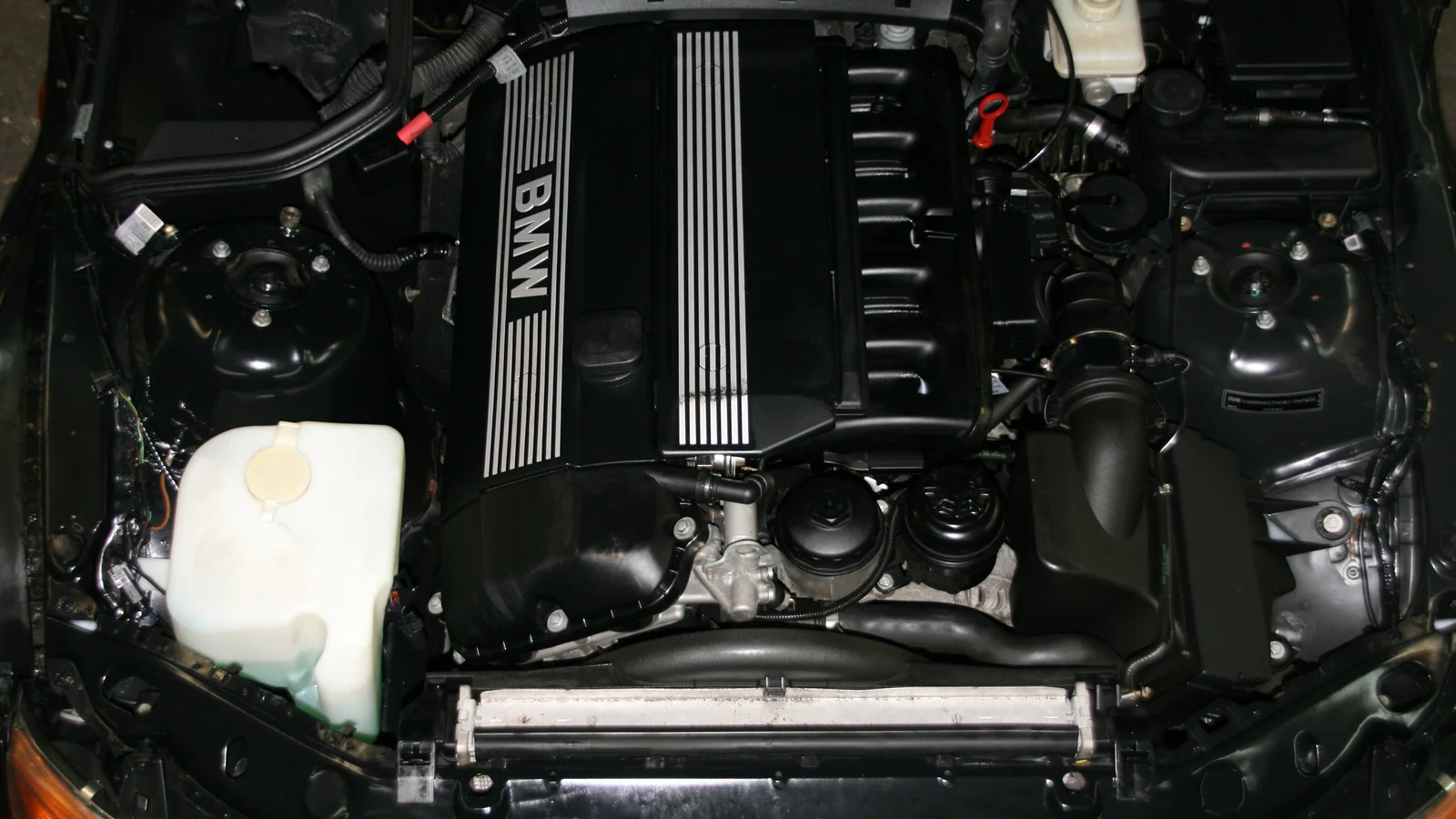

- Layout
- Inline-6 NA petrol
- Produced
- 1994–2000
The M52 is BMW’s 2.8-liter and 2.5-liter inline-six of the late 1990s — the engine of the E36 328i, the E39 528i and the Z3 2.8. It replaced the M50, moved BMW’s mainstream six to an aluminum block, and is the direct predecessor of the M54.
What the M52 is
A twin-cam inline-six with four valves per cylinder and VANOS variable valve timing on the intake camshaft, in 2.5 and 2.8-liter forms. The change from the M50 was the block: aluminum in place of cast iron, with Nikasil-coated bores on the early engines and Alusil on later ones. From 1998 the revised M52TU added VANOS on both camshafts.
Our archive holds no United States brochure from these years — the 1990s are the decade we are missing entirely — and certification records with rated power begin in 1998, at the very end of this engine’s life. So no horsepower figure appears here. What EPA fuel economy data does give, from 1984 onwards, is cylinder count, displacement and economy for every car sold, and that is enough to say precisely which cars had this engine.
Where it appears in the records
| Model | US model years | Displacement | Combined mpg |
|---|---|---|---|
| 328i, 328is, 328Ci, Convertible | 1996–2000 | 2.8 L | 19–21 |
| Z3 Roadster and Coupe 2.8 | 1997–2000 | 2.8 L | 18–20 |
| 528i, 528i Touring, Sport Wagon | 1997–2000 | 2.8 L | 19–21 |
| 323i, 323is, 323Ci, 323i Touring | 1998–2000 | 2.5 L | 18–22 |
| Z3 Roadster 2.5 | 1999–2001 | 2.5 L | 19–20 |
The 2.5-liter cars are worth a note. A BMW badged 323i has a 2.5-liter engine, not a 2.3-liter one, and the EPA record says so for every model year from 1998 to 2000. The badge and the displacement parted company well before the modern 330i made the point famous.
Where the M52 ends and the M54 begins
The changeover happened for the 2001 model year and it is visible as a displacement change in the same dataset: the 2.5-liter cars become 325i and the 2.8-liter cars become 330i with 3.0 liters. In the records, 2001 is the first year a BMW six is listed at 3.0 liters in the 3 Series and 5 Series — that is the M54.
So: a 2.8-liter BMW six is an M52. A 2.5-liter one badged 323i or 528i-era Z3 is an M52. A 3.0-liter one from 2001 onwards is an M54. The 2.5-liter 325i of 2001 is also an M54, which is the one case where displacement alone does not settle it and the model year does.
What we do not publish
No reliability rating, and no repetition of the Nikasil failure-rate figures that circulate. The bore-lining change is documented engineering history; the numbers attached to it in discussion are not traceable to any source we can check. The NHTSA complaint database records faults against a vehicle rather than an engine in any case, and a 1998 3 Series in it may be a four-cylinder 318i or a six-cylinder 328i.
Common questions
Which BMWs have the M52?
In the United States: the 328i, 328is and 328Ci, the 323i, 323is and 323Ci, the 528i, and the Z3 in 2.5 and 2.8-liter forms — model years 1996 to 2001 depending on the car.
How much horsepower does the M52 have?
We do not publish a figure. Certification records carrying rated power begin in 1998, and our brochure archive holds nothing from the 1990s. Displacement we can source exactly: 2.5 or 2.8 liters, by model and year, from the table above.
What is the difference between the M52 and the M52TU?
The TU — technische Überarbeitung, technical revision — added VANOS variable timing on the exhaust camshaft as well as the intake, from 1998. It is the same engine revised, not a different one.
Is a 323i really 2.3 liters?
No. Every US 323i in the EPA records, 1998 through 2000, is 2.5 liters. The badge marks the position in the range.
What replaced the M52?
The M54, from the 2001 model year, in 2.5 and 3.0-liter forms.
Sources
Cylinder counts, displacements, model years and fuel economy from EPA fuel economy data, with the source named on every specification page. No brochure from this period is held in the archive; the 1990s are the largest gap in our collection and the submission page explains what to send.