BMW M60 Engine
BMW M60 (1992-1996): specifications, power by application and every car that has it.
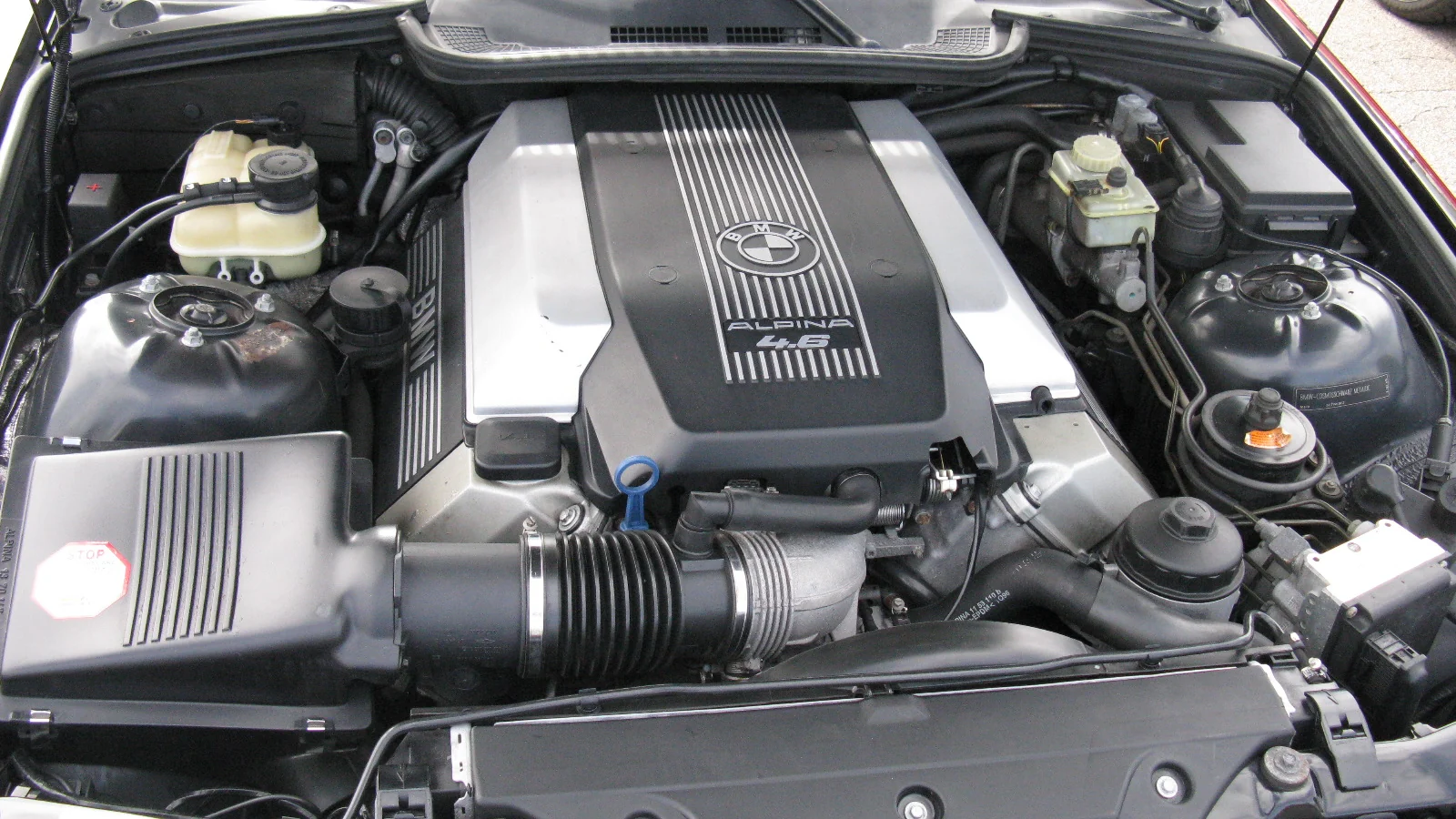

- Layout
- V8 NA petrol
- Produced
- 1992–1996
The M60 is BMW’s first modern V8, built from 1992 to 1996. It is the engine that returned BMW to eight cylinders after decades without one, and in the United States it powered the 530i, 540i, 740i, 740iL and 840Ci — including a 5 Series that is easy to overlook: a 530i with eight cylinders.
What the M60 is
An all-aluminum V8 with two overhead camshafts per bank, four valves per cylinder and a Nikasil-coated bore surface, in 3.0 and 4.0-liter forms. Every BMW V8 since descends from it — the M62, the N62, the N63, the S68 all follow.
Our archive holds no United States brochure from these years, and certification records carrying rated power begin in 1998, two years after the M60 finished. So this page publishes no horsepower figure. What we can source, from the EPA’s fuel economy records, is which cars had eight cylinders and how large those engines were — and that turns out to be the useful part.
Where it appears in the records
| Model | US model years | Displacement | Combined mpg |
|---|---|---|---|
| 740i, 740iL | 1993–1995 | 4.0 L | 16–17 |
| 530i, 530i Touring | 1994–1995 | 3.0 L | 17–18 |
| 540i | 1994–1995 | 4.0 L | 16–18 |
| 840Ci | 1994–1995 | 4.0 L | 16–17 |
Figures are from EPA fuel economy data, which has recorded cylinder count and displacement since 1984. The 3.0-liter entry is the one worth pausing on.
The eight-cylinder 530i
The E34 530i of 1994 and 1995 is a V8, and the government record proves it: eight cylinders, 3.0 liters, in a car whose badge reads exactly like the six-cylinder 530i that came before and the six-cylinder 530i that came after. BMW’s numbering has never promised a relationship between the badge and the engine, but few cars illustrate it as sharply as this one — the 1995 530i has eight cylinders, the 2001 530i has six.
If you are looking at a mid-1990s 5 Series and want to know which you have, count the plug leads or check the specification page for that model year. The badge will not tell you.
How to tell an M60 from an M62
By displacement and model year, and both are in the government record. The M62 replaced the M60 in the mid-1990s and grew the large V8 from 4.0 to 4.4 liters, and the change shows up as a clean break:
| Car | 4.0 L (M60) | 4.4 L (M62) |
|---|---|---|
| 740i / 740iL | 1993–1995 | 1996–2001 |
| 540i | 1994–1995 | 1997–2003 |
| 840Ci | 1994–1995 | 1996–1997 |
A 4.0-liter BMW V8 is an M60; a 4.4-liter one from before 2002 is an M62. That rule is read straight out of EPA fuel economy data rather than inferred, which is why we are willing to state it.
What we do not publish
No reliability rating, and no repetition of the Nikasil story in the form it usually appears. The NHTSA complaint database records faults against a vehicle, not an engine, and for cars of this age the surviving record reflects what was still being complained about years later. The bore-lining question is real engineering history, but the failure rates attached to it in circulation are not traceable to any source we can check, and we do not repeat numbers we cannot stand behind.
Common questions
Which BMWs have the M60?
In the United States: the 530i and 540i of 1994–1995, the 740i and 740iL of 1993–1995, and the 840Ci of 1994–1995.
How much horsepower does the M60 have?
We do not publish a figure. United States certification records carry rated power only from 1998, and we hold no brochure from these years. Displacement we can source: 3.0 liters in the 530i, 4.0 in everything else.
Was the 530i a V8?
In 1994 and 1995, yes — a 3.0-liter eight-cylinder. Before and after that, the 530i was a six. This is recorded in EPA fuel economy data for those model years.
What is the difference between the M60 and the M62?
Displacement and date. The M62 replaced it from 1996 and took the large V8 from 4.0 to 4.4 liters. See the table above for which car changed when.
What replaced the M60?
The M62, and after it the N62 with Valvetronic in 2001.
Sources
Cylinder counts, displacements, model years and fuel economy from EPA fuel economy data, which is also the source named on every specification page. No brochure from this period is held in the archive; if you have one, the submission page explains what to send.