BMW M62 Engine
BMW M62 (1994-2005): specifications, power by application and every car that has it.
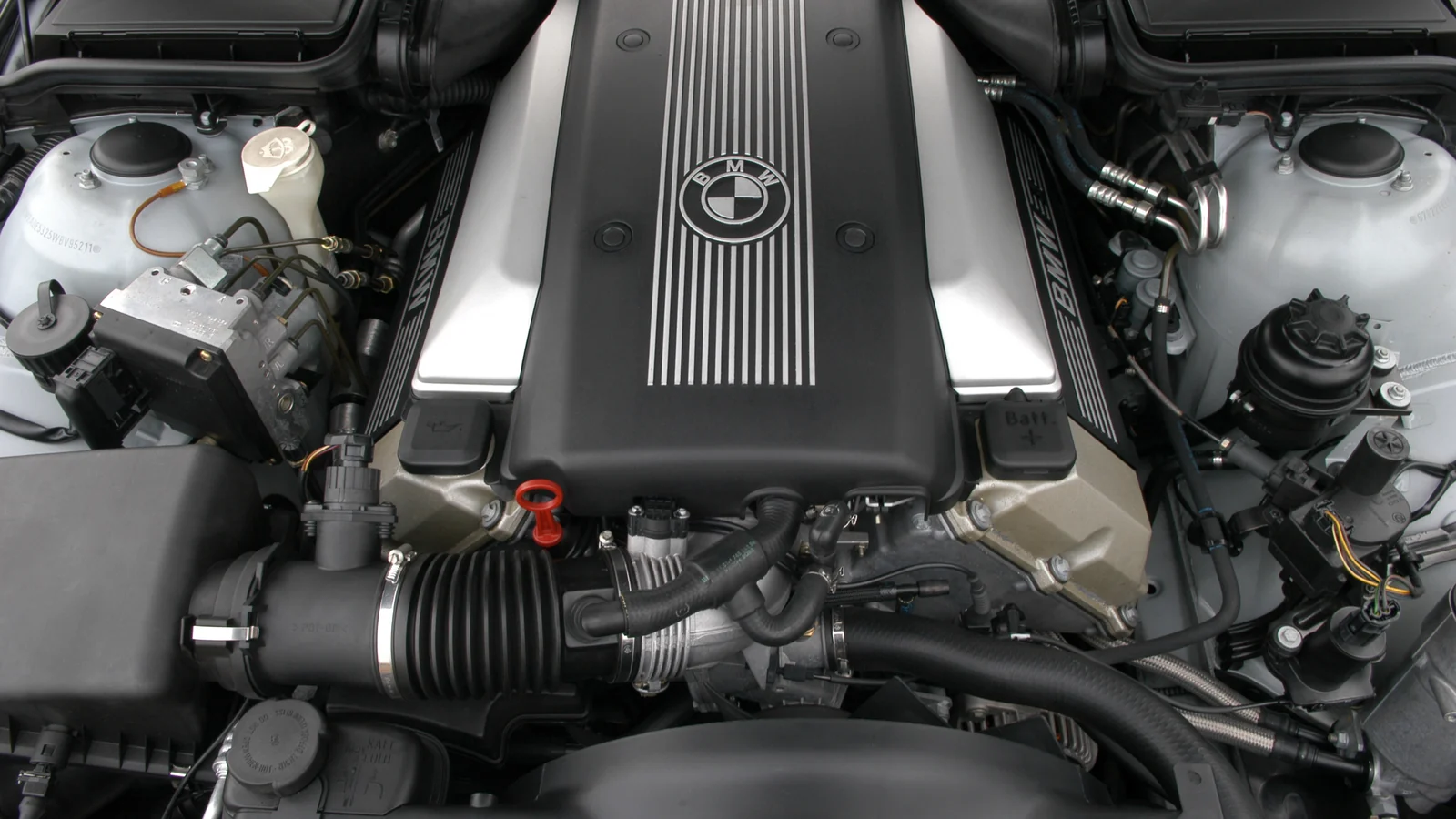

- Layout
- V8 NA petrol
- Produced
- 1994–2005
The M62 is BMW’s 4.4-liter V8 of the late 1990s and early 2000s — the engine of the E39 540i, the E38 740i, the first X5 4.4i and the 840Ci. It replaced the M60, and the change is visible in the government records as a clean step in displacement from 4.0 liters to 4.4.
What the M62 is
An all-aluminum V8 with two overhead camshafts per bank and four valves per cylinder, enlarged from the M60 that preceded it and later fitted with single-VANOS variable valve timing on the intake camshafts. It sits between BMW’s first modern V8 and the Valvetronic N62 that replaced it in 2001.
Our archive holds no United States brochure covering these cars — the oldest 5 Series and 7 Series documents we hold are from 2004, by which time the N62 had arrived — and rated power appears in certification records only from 1998. This page therefore publishes no horsepower figure, and what it does publish comes from EPA fuel economy data.
Where it appears in the records
| Model | US model years | Displacement | Combined mpg |
|---|---|---|---|
| 740iL | 1996–2001 | 4.4 L | 18 |
| 840Ci | 1996–1997 | 4.4 L | 15 |
| 540i, 540i Touring, Sport Wagon | 1997–2003 | 4.4 L | 16–18 |
| 740i | 1998–2001 | 4.4 L | 16–18 |
| X5 4.4i | 2000–2005 | 4.4 L | 14–16 |
The X5 entry runs to 2005 in the fuel economy records, which is later than the M62’s production span, and the reason is the changeover: the N62 took over the 4.4-liter X5 during that period. Displacement alone cannot separate them, because both are 4.4 liters. What separates them is Valvetronic and the model year, and for a specific car the VIN decoder resolves it.
The 4.0 to 4.4 step
Telling the M62 from the M60 is straightforward, because the displacement changed and the EPA recorded it:
| Car | 4.0 L (M60) | 4.4 L (M62) |
|---|---|---|
| 740i / 740iL | 1993–1995 | 1996–2001 |
| 540i | 1994–1995 | 1997–2003 |
| 840Ci | 1994–1995 | 1996–1997 |
A pre-2002 BMW V8 of 4.0 liters is an M60; one of 4.4 liters is an M62. There is no ambiguity in that window, and the rule comes out of a government dataset rather than out of a forum.
The one that is not an M62
The E39 M5 and the Z8 of the same years also have a BMW V8, and it is not this one. Those cars use the S62: 4.9 liters rather than 4.4, built by BMW M GmbH, with individual throttle bodies and Double-VANOS. It is a different engine that happens to share a family, which is the rule for every S-prefixed BMW engine and the subject of our guide to engine codes.
In the records the difference is visible immediately: 4.9 liters and 15 mpg for the M5 and Z8, 4.4 liters and 16 to 18 mpg for the 540i.
What we do not publish
No reliability rating. The NHTSA complaint database records faults against a vehicle, not an engine, and a 1999 5 Series in that database may be a six-cylinder 528i or a V8 540i without the record saying which. Any figure headed “complaints about the M62” was produced by splitting those records on an assumption.
Common questions
Which BMWs have the M62?
In the United States: the 540i of 1997–2003, the 740i and 740iL of 1996–2001, the 840Ci of 1996–1997, and the X5 4.4i from 2000.
How much horsepower does the M62 have?
We do not publish a figure. Certification records carrying rated power begin in 1998 and do not cover these engines, and we hold no brochure of the period. Displacement is 4.4 liters in every US application.
What is the difference between the M60 and the M62?
Displacement, principally: 4.0 liters against 4.4. The M62 replaced the M60 between 1996 and 1997 depending on the model, and the table above gives the exact year for each car.
Is the M5 V8 an M62?
No. The E39 M5 and the Z8 use the 4.9-liter S62, an M division engine with individual throttle bodies. The 4.4-liter M62 is the ordinary V8 of the 540i and 740i.
What replaced the M62?
The N62 from 2001, the first production engine with Valvetronic. It kept the 4.4 liters and added a 4.8-liter version.
Sources
Cylinder counts, displacements, model years and fuel economy from EPA fuel economy data, with the source named on every specification page. No brochure covering these cars is held in the archive.