BMW S14 Engine
BMW S14 (1986-1991): specifications, power by application and every car that has it.
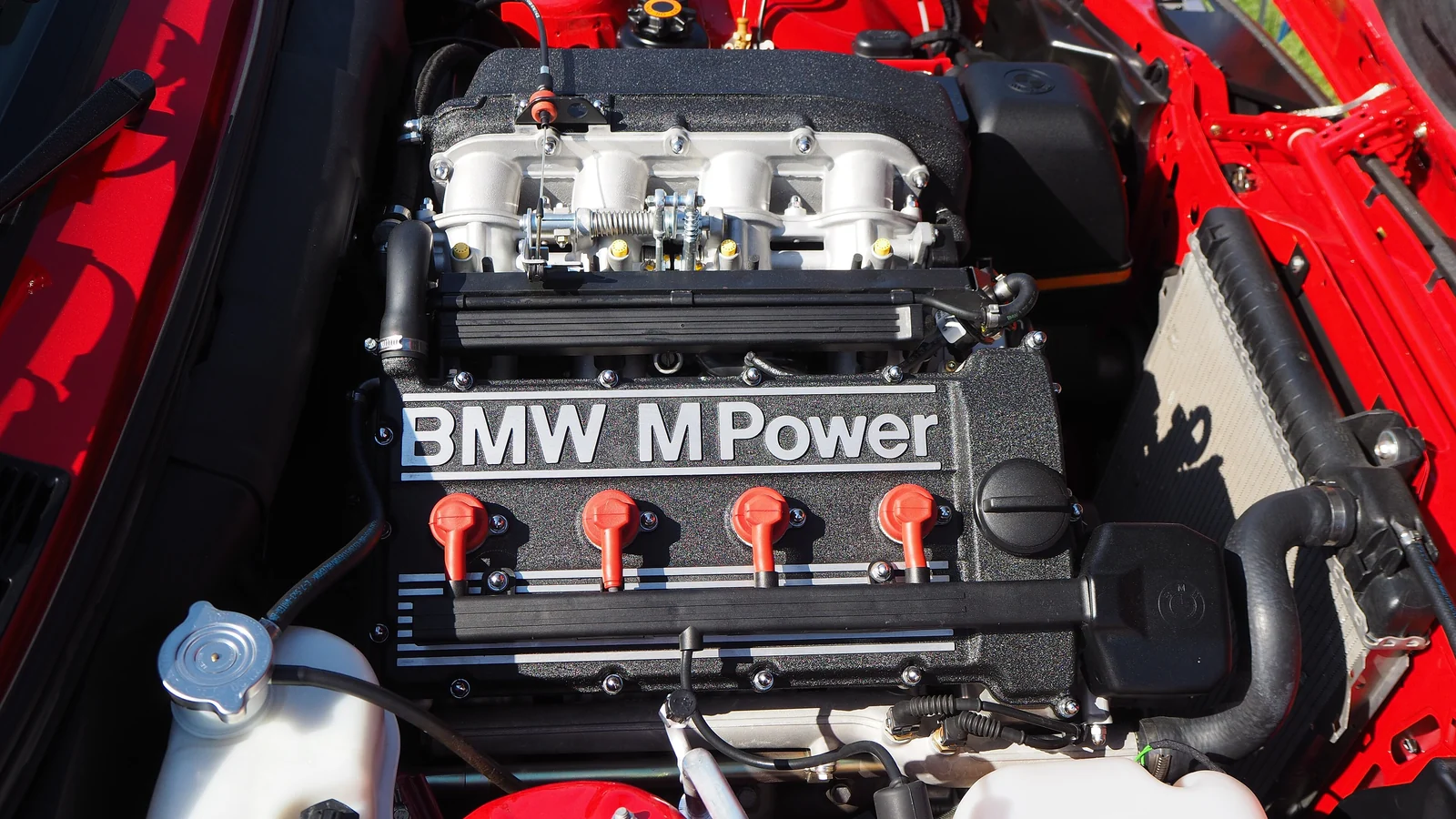

- Displacement
- 2.3 L
- Layout
- Inline-4 NA M petrol
- Produced
- 1986–1991
The S14 is the engine of the E30 M3: a 2.3-liter four-cylinder built by BMW M GmbH from 1986 to 1991. It is the only four-cylinder engine ever fitted to an M3, and it was built for one reason — to make the car eligible to race.
What the S14 is
A 2.3-liter inline-four with two overhead camshafts, four valves per cylinder and four individual throttle bodies. The S prefix means it was built by BMW M GmbH rather than BMW AG, and as our guide to engine codes explains, that makes it a separate engine rather than a tuned version of an ordinary one.
Its construction is unusual even by M standards: a four-cylinder block from BMW’s M10 family with a four-valve cylinder head derived from the six-cylinder M88 line — effectively two thirds of a six-cylinder racing head on a four-cylinder bottom end.
Where it appears in our records
| Model | US model years | Cylinders | Displacement |
|---|---|---|---|
| M3 (E30) | 1989–1991 | 4 | 2,300 cc |
Three specification pages, and the interesting part is not that they exist but what is in them: four cylinders and 2,300 cc, against six cylinders and 3,000 cc for the 1995 M3 in the same dataset. The generation change from E30 to E36 is visible in the government record as a change in cylinder count, which is a cleaner piece of evidence than any description.
Rated power is absent, as it is for everything before 1998 — United States certification records did not carry it then, and we hold no brochure of the period.
Why a four-cylinder M3
Group A touring car racing required a manufacturer to build road cars closely related to the racing version, in quantity. The E30 M3 exists because BMW needed a homologated car, and the S14 exists because the racing regulations favored a light, high-revving four over a heavier six.
Every M3 since has had more cylinders: six in the E36 and E46, eight in the S65-powered E9x, six again with turbocharging in the S55 and S58 cars. The four-cylinder M3 was a one-off answer to a rulebook rather than a step in a progression.
How to tell a real E30 M3
The bodywork is different from an ordinary E30 in ways that are expensive to fake — but the check that cannot be faked at all is the VIN. Cars built by BMW M GmbH carry WBS as their first three characters rather than the WBA of a BMW AG car, and our VIN decoder reads that straight out of the number.
A 325i with M3 panels is still a WBA car. Given what E30 M3s are now worth, that is a check worth two minutes.
What we do not publish
No reliability rating. The NHTSA complaint database records faults against a vehicle, not an engine, and for a car this old and this rare the surviving record reflects what owners were still complaining about decades later. We also publish no power figure, because no source we hold carries one for these years.
Common questions
Which BMWs have the S14?
One: the E30 M3, in the United States from 1989 to 1991. Some European versions and the homologation specials used higher-output variants of the same engine that were not sold here.
How much horsepower does the S14 have?
We do not publish a figure. Certification records carrying rated power begin in 1998, seven years after this engine finished, and our archive holds no brochure covering the E30 M3. What we can source is the configuration: four cylinders, 2,300 cc.
Is the E30 M3 really a four-cylinder?
Yes, and the EPA record confirms it for every US model year: four cylinders, 2.3 liters. It is the only M3 that has ever been one.
Is the S14 related to the M10?
It uses the M10 four-cylinder block as its foundation, with an M division four-valve head on top. They are not the same engine and share little beyond that starting point.
What replaced the S14?
The S50 six-cylinder in the E36 M3, from 1995 in the United States — visible in our records as the year the M3 goes from four cylinders and 2.3 liters to six and 3.0.
Sources
Cylinder counts, displacements and model years from EPA fuel economy data, with the source named on every specification page. Manufacturer identifier decoding from the VIN structure itself, as described on our VIN decoder page. No brochure covering the E30 M3 is held in the archive.