BMW M88 Engine
BMW M88 (1978-1989): specifications, power by application and every car that has it.
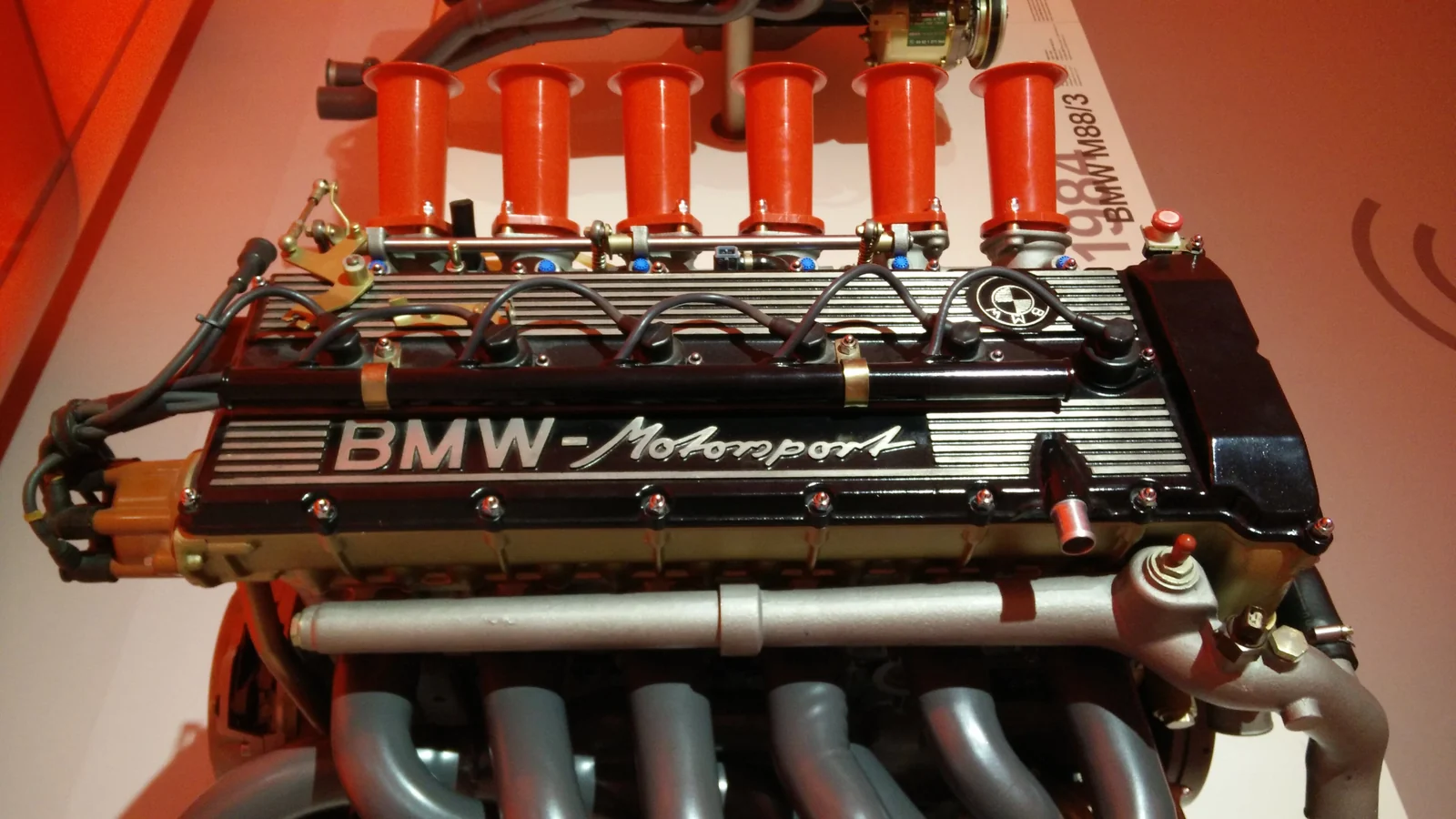

- Layout
- Inline-6 NA motorsport
- Produced
- 1978–1989
The M88 is BMW’s first true motorsport engine for a road car: a 3.5-liter inline-six with four valves per cylinder and six individual throttle bodies, built from 1978. It powered the M1 — the only mid-engined car BMW has ever sold — and it is the ancestor of every M-division six that followed.
What the M88 is
A 3.5-liter inline-six with twin overhead camshafts, twenty-four valves, six individual throttle bodies and dry-sump lubrication. Its block comes from the M30 Big Six; its head does not, and the head is the engine. The combination — a production block under a racing head — is the same recipe BMW M used again for the S14 in the E30 M3.
Dry-sump lubrication is the detail that gives the design away. It exists so the engine can be mounted low and run at sustained cornering loads without oil surge, which is a racing requirement rather than a road one.
Why we have no data for it
The M1 was sold in the United States in 1981 in small numbers. Our records cannot see it: EPA fuel economy data begins in 1984 and certification data with rated power in 1998, and our brochure archive holds nothing earlier than 1955 Isetta material and then nothing again until 1985.
So this page has no specification table, no horsepower figure and no fuel economy. Every other engine page here names the government record or the brochure a number came from; for the M88 there is nothing to name, and we would rather say that than repeat figures from elsewhere.
One thing our data does support: the M1 is in this site’s model records, and if a period brochure ever reaches the archive the page will be rebuilt around it. The submission page explains what to send.
What it became
The M88 line did not stop with the M1. The S38 of the E28 and E34 M5 and the E24 M6 is its development for a front-engined sedan, adapted for markets with stricter emissions rules — and that engine is in our records, in the 1991 to 1993 M5.
Trace the line forward and it runs through every M six: the S38, the S50 and S54 of the E36 and E46 M3, and the turbocharged S55 and S58 of today. The individual throttle bodies survived until turbocharging made them unnecessary; the principle that an M engine is a separate design rather than a tuned one has survived entirely.
What we do not publish
No reliability rating, no power figures and no specification table. The NHTSA complaint database records faults against a vehicle, not an engine, and for a car sold here in the hundreds four decades ago there is no usable record in it. Anything you read as a durability verdict on the M88 is anecdote about a handful of cars.
Common questions
Which BMWs have the M88?
The M1, the European M635CSi and the European E28 M5. In the United States the M1 was the only one, and its successors here used the S38 instead.
How much horsepower does the M88 have?
We do not publish a figure. No government record we use reaches back to 1981, and we hold no brochure covering the M1. Figures circulate; none of them can be traced to a source we hold.
Is the M88 the same as the S38?
Same design line, different engines. The S38 is the M88 developed for front-engined sedans and for emissions-regulated markets, and it is the one that reached the United States in the E34 M5.
Is the M88 related to the M30?
It uses the M30 block as its foundation, with a four-valve twin-cam head of M division design on top. The bottom end is a large sedan-car engine; the top end is not.
How do I tell a real M1?
Start with the VIN. Cars built by BMW M GmbH carry WBS as their first three characters rather than WBA, and our VIN decoder reads that out of the number directly.
Sources
None for the engine itself, and the page says so above. The relationship to the S38 and its appearance in the 1991–1993 M5 come from EPA fuel economy data, which is named on every specification page.